Monday, March 29, 2010

MTNA 2010


The MTNA - Music Teachers' National Association (http://www.mtna.org) was founded in 1876 by Theodore Presser in Delaware, Ohio. Its aim then, as now, was to advance the value of music study and music making to society and to support the professionalism of music teachers.
The 2010 MTNA was in Albuquerque, New Mexico. Numbers were down from last year - the economic downturn being the major factor - but it was a very worthwhile convention for me and my colleagues from Novus Via Music (www.nvmusicgroup.com)

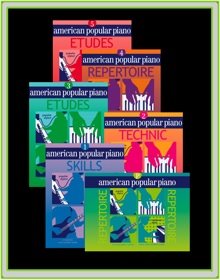
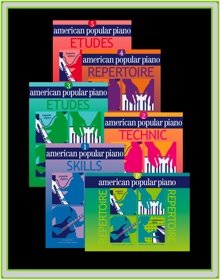
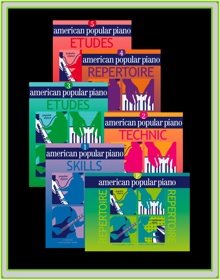
I first attended MTNA in Portland in1987, where I launched Microjazz on an unsuspecting American public. And in 2007 in Toronto I launched both Connections and American Popular Piano. This year Scott McBride Smith and I gave a presentation grandly entitled Effective Practice(s) to Direct Success, which outlined why we think American Popular Piano is an excellent way to encourage good practice habits from an early stage.

Lots of seminars go on throughout MTNA, as well as concerts, masterclasses and competitions. There is also an extensive trade area, where I was to be found much of the time. Here's a picture of the Novus Via stand. Can you spot me?


I was gratified by lots of comments from teachers about how they are finding American Popular Piano - many teachers have started to incorporate the series into their teaching and have been delighted with pupil reactions. One teacher from Oregon gave a glowing testimonial during our presentation - with all the right terms: pupil-saver, great for boys, encourages students to practice...

One of our earliest adopters, Jon Michael Iverson was at the convention and played some ensemble pieces with me. Here he is at the piano on our stand:


That's a look of rapt concentration isn't it! Jon's website includes The Christopher Norton Project, where you can see great student performances of Connections and American Popular Piano pieces.

MTNA was a great chance to see colleagues from all over North America and beyond - from Clavier Companion (I write a column for them) Schott Music, Hal Leonard, MYC and EPTA. I was also delighted to attend a reception for Ingrid Clarfield - a documentary is being made about her recovery and continuing work as a teacher after suffering a debilitating stroke 2 years ago. One of her students was almost overcome when she realised who I was (and yes, she is from Canada..)

MTNA was a very happy time and I am beginning to feel optimistic about American Popular Piano making its way in the world. Next year Milwaukee!


Thursday, January 28, 2010

DS Music, Monmouth

DS Music in Monmouth is a very lively music store that also provides music lessons, has a thriving mail order business and a very enthusiastic and youthful staff. Here’s a picture of the shop, right in the middle of Monmouth’s delightful town centre:
DS Music

The store owner, Jon Petrie, hit on the rather inspired idea of having the workshop in the upstairs room of an excellent Indian restaurant, literally across the road from DS Music. The teachers who came to be entertained and enlightened by me were also fed some high-quality Indian food at the end of proceedings! Here’s a picture of Jon, a musician himself:
Jon Petrie

I did the American Popular Piano and Microjazz demonstrations in one uninterrupted presentation – the promise (and smell) of the food meant that there was a certain pressure not to go over time! A number of teachers came up to play duets with me and also to have a go at improvising and I felt there was a very good understanding from the people there of what I was trying to do. DS Music had a comprehensive selection of music on display and there was lots of interest in the books in evidence at the end, despite the lure of the chicken korma.

I hope to get back to Monmouth again before too long, to perhaps work in some other local schools as well as with local teachers.

Haberdashers Monmouth School for Girls

Haberdashers Monmouth School for Girls enjoys an outstanding academic reputation but it is also justifiably proud of its national and international sporting and musical achievements.
Its excellent facilities include a sixth form centre, science laboratories, music rehearsal and recording studio, indoor pool, sports hall and all-weather pitch. Here’s a photo of the striking main buildings:
Haberdashers School for Girls
I initially spoke to a large Year 8 class and spoke about being a composer, with lots of music examples, some of which involved students coming up to play. It was a fun session and I think the girls enjoyed it!
Then I had a group of GCSE students and they expressed nervousness about writing their own compositions. So I decided to get a number of students to come up and start an idea off (at the piano) and I then showed them how you could take a short melodic idea (one was 2 notes!) or a rhythm or a bit of text and make a composition from it. My chief assertion was that they should stop trying to write one perfect piece and instead write lots of pieces so that it became less of an obstacle to progress. We touched on the three fundamentals of composition:

Getting started
Continuing
Finishing!

This was a most enjoyable session and I think the girls went away more confident in their ability to come up with ideas and develop them quickly and spontaneously.

Wednesday, January 27, 2010

The Cathedral School, Cardiff

The Cathedral School, Llandaff is a coeducational independent day prep school located in Llandaff, Cardiff and has many links to Llandaff Cathedral.

Music at the Cathedral School is very strong, with many pupils at Grade 8 standard. The music department is housed in the impressive state-of-the-art Jubilee building. There are also specialist teachers for 20 different instruments. There are numerous school groups as well, including school orchestra, swing band and chamber choir.

The Head of Music, Michael Hoeg, asked me to come for a full day and it proved to be a very enjoyable day. Here he is (on the right) with the school’s Head of Brass:

Cathedral school music staff

I started with some master classes with students – pieces from the Concert Collections as well as Microjazz were played by a variety of instrumentalists (solo piano included) They all performed very well and it was clear how a comprehensive programme of instrumental tuition really can pay off!

I then worked with year 9 GCSE composition students, with students from other years sitting in. I got the students to get some ideas going on the spot, using their computers to notate their ideas as best they could. I then took those ideas and suggested various ways they could be developed, including ad hoc arrangements for the whole group to join in on. Here’s one of my cheerful composition students at the end of the session:

After lunch, I talked to a smaller group called the Scholars’ Society about my life as a composer. This group has talks from various visiting luminaries – I think I may have been their first music composer!

Finally, I did a workshop on improvisation, using pieces from American Popular Piano. This featured students who were very new to improvising in the main and they did very well. I also jammed with a student who had already done quite a bit of improvising and he found it particularly useful to have his ideas analysed and reined in somewhat – the result proved to be very satisfying for him as well as for the audience. This was a very stimulating end to a fun day. Here is my star improviser at work:

Cathedral school improvisation student

This was an excellent template for day in a school – master classes, work on composition, a talk on my life as a composer and an improvisation session. As Michaek Hoeg said to me in a subsequent email:

Thank you so much for coming to work with us yesterday. I have had a great many positive comments from both students and staff and, speaking personally, I learned a great deal myself. I hope that one day you will be able to come and see us again.