Thursday, September 10, 2009

Score Store, Wokingham at Leighton Park School, Reading, UK

This was a workshop specifically for private piano teachers and we were lucky to be able to use the concert hall (and Steinway grand) at Leighton Park School, a Quaker independent school set in rolling parkland not far from the centre of Reading (www.leightonpark.reading.sch.uk) Every teacher present was already familiar with my name and with Microjazz and other Boosey & Hawkes’ materials; none of them had come across American Popular Piano before. They had some initial questions about the series, for example:
Q: Why is the term “American” in the series’ name?
A: We have used a range of popular styles in APP with which America has become strongly identified
Q: How would you persuade a parent that 4 books per Level is a justifiable investment?
A: We hope that the usefulness of all the elements in APP across an entire year will prove to be in fact very good value for money!
Here are the some of the teachers who came to the workshop:
Teachers at the Reading workshop

I began by playing some APP pieces – I find that if people like the pieces right away, you’re in with more of a chance!
CN plays..

I then went on to give an overview of the present state of piano teaching and the difficulties faced by teachers trying to compete for students’ attention in the face of homework, sport, computer games and other activities perceived as more “cool” than piano-playing. There was some lively discussion about why students give up at various stages and we touched on the fact that students often play a range of music on the piano but listen to a completely different range of music back at home.. I then explained that APP is designed to use music in styles familiar to the student, but without sacrificing the fundamentals of good piano playing, sight-reading and ear-training.

I then moved through the Repertoire books, illustrating the 3 main categories – lyrical pieces, rhythmic pieces and ensembles – with some help from the audience as well as video clips of student performances. Here’s one of the teachers who was brave enough to come up and play for the group:
A teacher helps to demonstrate APP.

The teachers liked the Repertoire books, especially the fact that there are Ensembles, with teacher accompaniment and backing track, at every Level. But it was the Etudes books that really got their attention – a way of teaching improvisation that virtually anyone can feel comfortable with. I had a teacher improvising – she was actually quite an experienced improviser already, but she found the way APP keeps things very simple and ordered very useful. And the group agreed that the range of styles and the use of “authentic” left-hand voicings (generally in inversion) was both stimulating musically and applicable right away with students.

Another question came up – there was an ABRSM examiner there and she asked how the APP material (and approach) related to the ABRSM jazz syllabus. I said that there were inevitably overlaps (particularly blues pieces) but that the overall range of styles in APP is very different from the ABRSM syllabus – much more popular music than jazz style-wise. APP also progresses much more steadily from one Level to the next than any UK syllabus. I feel that APP is a good way of getting students (particularly at an absolute beginner level) comfortable with improvisation, so it is a useful way of preparing to work on more specifically jazz material.

We had a break at this point and the teachers looked at the books supplied by Score Store. Here are some enthusiastic teachers perusing the materials:
Teachers looking at the books

In Part 2, I did a quick overview of the Boosey & Hawkes’ materials, obviously referring to Microjazz (some teachers were new to the Microjazz Trios, for 6 hands) but also to Microstyles, the Concert Collections, the Easiest Way To Improvise, the Essential Guides, the Preludes Collections and the new Microswing, MicroLatin and MicroRock books. I played quite a few pieces, some with tracks and was able to get the teachers roughly up to speed with what I’ve written since 1983!

This was a very friendly and positive group and I’d like to thank both Score Store Wokingham (www.scorestore.co.uk) and Leighton Park School for hosting the event so well. I hope the teachers who bought APP sets to try out with their students will come back to the websites (www.christophernorton.com and www.americanpopularpiano.com) and let us know how they are getting on!

Some final pictures:
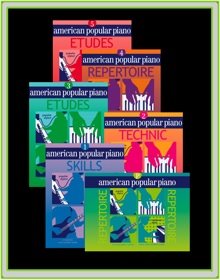
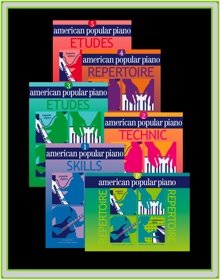
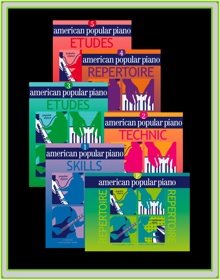
The range of books ...
Absorbed!

Monday, September 7, 2009

Workshop at Chetham's School of Music, Manchester

Report on Christopher Norton workshop at Chetham’s School of Music, Manchester, UK, August 25th 2009

With 290 or so students aged 8 - 18, Chetham’s is the largest specialist Music School in the UK and the only Music School based in the North of England. The annual Summer School for pianists is now in its ninth year. There is no other summer school that manages to cater for adult amateurs, promising children and observers! All are welcome on the course - concert pianists, international young artists preparing for top competitions, and professional music teachers. I was invited to do a presentation at the 2009 Summer School and, as I expected, I addressed an interesting mix of students, teachers and yes, observers! Here’s a cross-section of the audience:


One person I spoke to was from Phoenix. Arizona (second row up) another was not a specialist music teacher but interested in getting a Venezuelan-style scheme youth music scheme going in London. There were also a couple of teachers who played in a piano duo. And lots of students, perhaps happy to do something a little less intense than the practicing and performing they had been doing the rest of the time!

I soon realized that some of the audience didn't know who I was, let alone anything about Microjazz, so I began by giving a mini-historical overview, including my own classical piano background in New Zealand and how Microjazz came to be, so to speak. I played various pieces from Microjazz, Microstyles, the Concert Collection and Preludes and as always included some fun audience participation. Here’s one of my “students”, still looking cheerful after coming up on stage with me

Then I got onto American Popular Piano and went through the basics of this unique piano course. This always requires some audience participation, an entertaining element (particularly for the observers) Here’s a student who helped me out on the improvisation front:

This really was a flying visit, as I had to get back to Leeds to celebrate my elder daughter’s engagement (see the picture at the top!) The mix of audience that Chetham’s Summer School creates is great – students who are looking for new repertoire, teachers who want to hear something fresh on the pedagogical front and amateurs who are just interested in the whole process of piano playing and teaching. It was a privilege to be a part of this year's Summer School.


Wednesday, August 5, 2009

NCKP 2009 in Chicago IL

NCKP (http://www.francesclarkcenter.org) stands for the National Conference of Keyboard Pedagogy. It’s a bi-annual conference that brings together academics, private music teachers and music industry professionals from across the US and Canada. The 2009 delegate list reads like a virtual “Who’s Who” of keyboard music education in America. I was at NCKP representing Novus Via Music and I both co-presented a session on American Popular Piano (www.americanpopularpiano.com) and also worked in the conference exhibit hall with many of the delegates, showing them the music but also guiding their first steps at improvising.

The interest in American Popular Piano proved to be amazingly strong and our showcase proved, even at 8.00 am, to be the biggest draw of the conference. There was a palpable buzz about our company and our ever-expanding product line, underlined by the fact that we sold out of books!


The strong interest in evidence at NCKP is partly because Scott McBride Smith and I have been doing lots of promotional work around North America (see previous blogs) But I also felt that North American music teachers are ready for something fresh and are also as a group starting to pay more than lip-service to improvising as a component of their teaching programmes. I worked with quite a number of teachers on how the APP approach to improvisation works and they were all very keen to take the books home and try them out right away. Here I am with a very happy Amy Immerman (from Ohio)


The stand at the exhibit was a hive of activity much of the time – here’s a picture of Scott McBride Smith (he’s the tall one!) deep in conversation with a teacher while other people peruse the (diminishing) stocks.

Shortly after this photo was taken, Scott flew off to Oregon to present American Popular Piano at the Oregon Music Teachers Association. Here is a testimonial from one of the teachers in Oregon:
"I am a classically trained jazz/improv pianist—a high level professional plus fully certified and licensed as a Music Specialist in Oregon K-12 with Masters Degree in Music Education & piano. I think American Popular Piano is the finest series I have ever seen for the students we have today taking piano for enjoyment, not competitions. I am so sold—I literally RAN to the OMTA vendor booth and bought the first set at this weekend’s OMTA conference and am already filling out order requests for a bunch more."

Jon Michael Iverson was also at NCKP and played ensemble pieces with me. Some of the videos he has created with his students were a great hit during the showcase. You can hear (and see) more of them at www.jonmichaeliverson.com. Look for The Christopher Norton Project….

We were very fortunate to have Richard and Isaac Holbrook (www.holbrookpiano.com) assisting us – they are former pupils of Scott McBride Smith and Carolyn Shaak who have both gone on to make careers in music, including helping to run a prestigous summer music camp for gifted students from around the world – iiym (www.iiym.com) Here is Isaac with Rosa, a teacher who helped me during the showcase by acting as my student and being instructed on improvisation from APP Etudes Level 1, on stage. A brave girl!

NCKP was a wonderful chance to meet colleagues, see my growing number of American teacher friends (including the organiser of my recent Boston workshop, Kathy Maskell) and feel a dramatic surge of interest in American Popular Piano. This could be the beginning of something big! There were also a number of enquiries about visits to teacher groups and music schools which may well create a whole programme of North American events in 2010.

Tuesday, July 14, 2009

Summer Sizzle 2009 Ontario Canada

Summer Sizzle is a summer music camp for piano teachers and piano students, held in a lovely small town in southern Ontario, Palmerston. It was the 9th year for Summer Sizzle this year and the biggest attendance yet. There were lectures and seminars for teachers, master classes and one-on-one sessions for students, improvisation workshops and a Keyboard Kamp (spelling deliberate!) for the children, run by a number of very able and enthusiastic musicians. Here are some of the students who took part in Summer Sizzle in 2009:

I was asked to run a series of improvisation sessions, using American Popular Piano Preparatory Etudes right through to Level 7 Etudes. My first session was for absolutely all participants and it was great fun – I got lots of students to come and try improv ideas out, with me and with tracks and I also got the whole group to do things. It set the tone for subsequent sessions, which were for smaller groups of students. Here’s one of my students, jamming away and concentrating hard!

I started the improv sessions with individual students but finally worked my way to having 8 students on 4 keyboards, all taking turns to solo but often keeping chords or riffs going under the other soloists.

Yup, that’s me in shorts..

Scott McBride Smith meanwhile was supervising master classes – students were asked to prepare pieces by er, me and he imparted his amazing teaching wisdom both to the players and to the onlookers. Here he is with a student:

The best 15 students were chosen (by Scott) to play in a Christopher Norton concert on the Monday night and I felt that Scott’s work plus the improvisation sessions meant that something really special happened. The students played with confidence and verve (including some jamming on stage) and the audience was positively electrified by the atmosphere of the event.

As you can see, I jammed along with the students some of the time in the concert, which was unrehearsed but worked wonderfully well most of the time.

I also did a seminar on vertical harmony (the analysis of chords divorced from functional harmony) and I think most teachers found this interesting! My aim was to get teachers enthused about individual chords (and recognizing them as well) all over again.

This was a really special music camp and I hope I might get back there next year. Hopefully we will see some readers there too!